

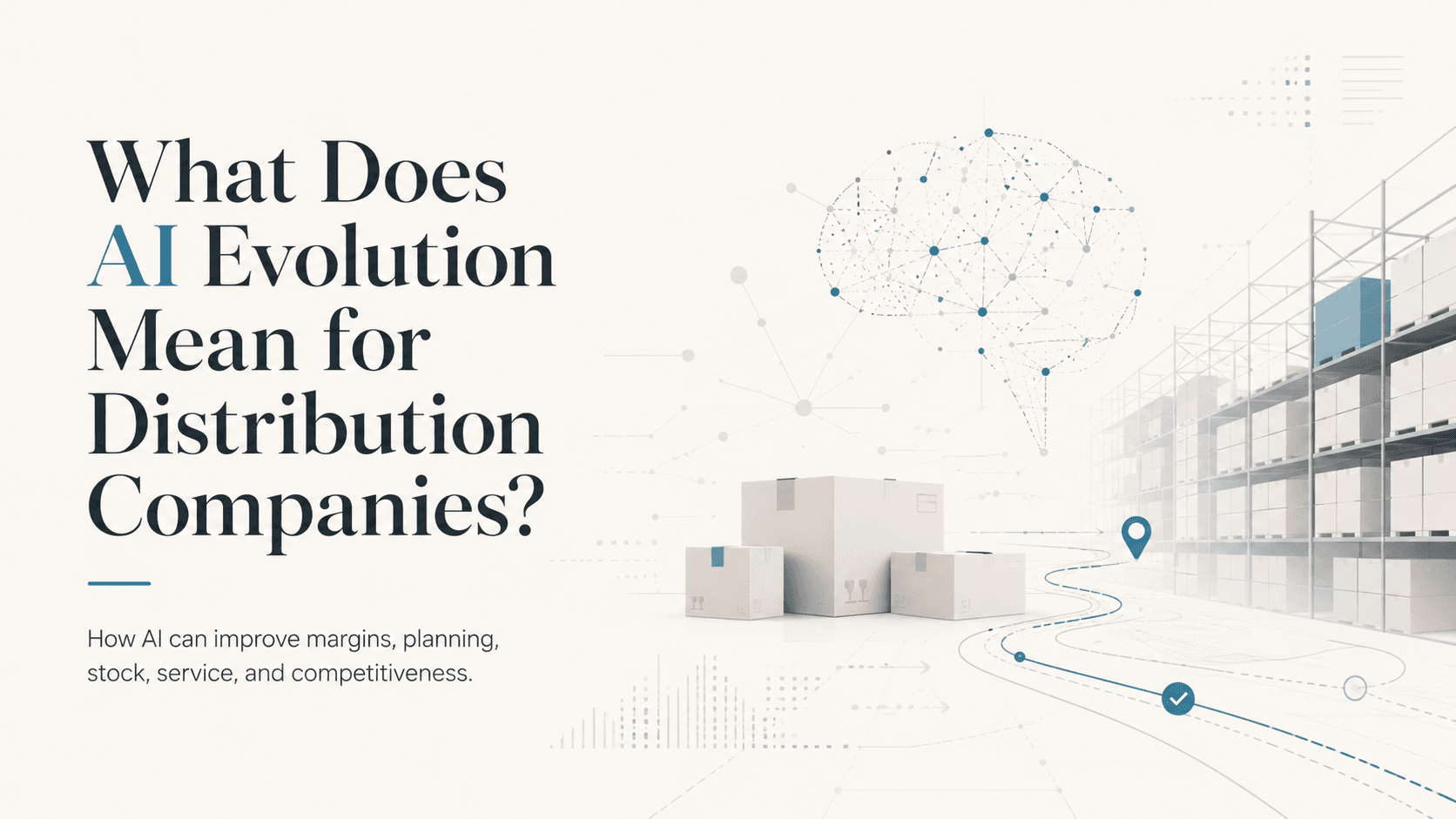
For many distribution companies, Artificial Intelligence may still feel like something distant.
It may seem like a topic for technology companies, large corporations, or businesses with advanced digital teams.
But that view is becoming risky.
AI is no longer just a technology trend. It is becoming a practical business tool that can affect margins, service quality, operational efficiency, customer satisfaction, and competitiveness.
For distribution companies, this matters because distribution is a business built on coordination.
At first glance, a distributor buys and sells products. But in reality, distribution companies manage much more than that.
They manage suppliers, purchasing, stock, warehouses, logistics, pricing, sales channels, customer relationships, deliveries, returns, warranties, support requests, repairs, refurbishments, and sometimes field service.
Some distributors sell to businesses. Others sell directly to consumers. Many do both.
Some distribute food or fast-moving consumer goods. Others distribute machinery, equipment, spare parts, electronics, industrial products, medical supplies, furniture, construction materials, or specialized products.
The sectors may be different, but the core challenge is usually the same:
How can we deliver the right product, to the right customer, at the right time, with the right margin, and with the lowest possible operational waste?
AI can help answer that question.
And more importantly, AI can help your competitors answer it too.

1. The Real Risk Is Not AI. It Is Your Competitor Using AI Better Than You.
Many business leaders are asking:
“Should we use AI?”
A better question is:
“What happens if our competitors use AI before us?”
Imagine a competing distributor that can forecast demand more accurately.
Imagine they can reduce stockouts and excess inventory.
Imagine they can prepare commercial proposals faster.
Imagine they can respond to customers more quickly.
Imagine they can optimize warehouse operations.
Imagine they can plan deliveries better.
Imagine they can reduce support costs.
Imagine they can identify margin problems earlier.
Imagine they can manage repairs, warranties, and field service with less manual coordination.
These improvements may not happen all at once. But even small improvements across several areas of the business can create a major competitive advantage.
A distributor that becomes faster, more efficient, and less expensive to operate can compete with better prices, better service, faster delivery, or more flexible commercial conditions.
That is why AI matters.
Not because it is fashionable.
Because it can change the cost structure and service level of a distribution business.
2. Distribution Companies Compete on Margins, Speed, and Reliability
Distribution is often a high-pressure business.
Margins can be tight. Customers expect availability. Suppliers change prices. Deliveries need coordination. Stock needs control. Warehouses must operate efficiently. Sales teams need accurate information. Support teams need visibility. Finance teams need reliable data.
- Small inefficiencies can quickly become expensive.
- A product ordered too late can mean a lost sale.
- Too much stock can damage cash flow.
- Poor planning can create waste.
- A delayed customer response can damage trust.
- A warehouse error can affect delivery performance.
- A missing spare part can delay a repair.
- A poorly planned field service visit can increase costs and frustrate the customer.
AI can help reduce these frictions. Not by replacing the business knowledge of your people, but by helping them make faster, better, and more informed decisions.
3. Where Can AI Improve a Distribution Business?
AI can create value in many areas of a distribution company. The most relevant use cases depend on the sector, but several opportunities apply to most distributors.
Sales and Customer Acquisition
For distributors, sales efficiency is critical.
Whether the business is B2B, B2C, or both, acquiring and retaining customers has a cost.
AI can help reduce that cost by supporting sales teams with:
- Lead qualification.
- Customer segmentation.
- Proposal preparation.
- Follow-up suggestions.
- Cross-selling and upselling opportunities.
- Customer history summaries.
- Personalized communication.
For B2B distributors, AI can help identify customers whose purchasing volume is decreasing, customers who may need replenishment, or customers who may be interested in related products.
For B2C distributors, AI can help improve product recommendations, marketing campaigns, customer targeting, and online sales performance.
This matters because customer acquisition cost can make or break a business.
If one distributor can acquire customers and serve them at a lower cost than its competitors, that distributor gains a clear advantage.
Demand Planning and Purchasing
One of the biggest challenges in distribution is deciding what to buy, when to buy it, and how much to buy.
This is especially important in sectors such as food distribution, where expiration dates, seasonality, supplier lead times, promotions, and logistics constraints all matter.
But the same principle applies to many other sectors.
Industrial distributors need to manage technical products and spare parts.
Equipment distributors need to plan machines, components, and accessories.
Retail distributors need to understand demand peaks and customer behavior.
AI can help analyze historical sales, seasonal patterns, stock levels, supplier performance, customer demand, and market trends.
This can reduce two expensive problems:
Stockouts, where the company loses sales because products are unavailable.
Excess stock, where cash is trapped in inventory that moves too slowly.
Better planning means better cash flow, better customer service, and better margins.
Warehouse Efficiency
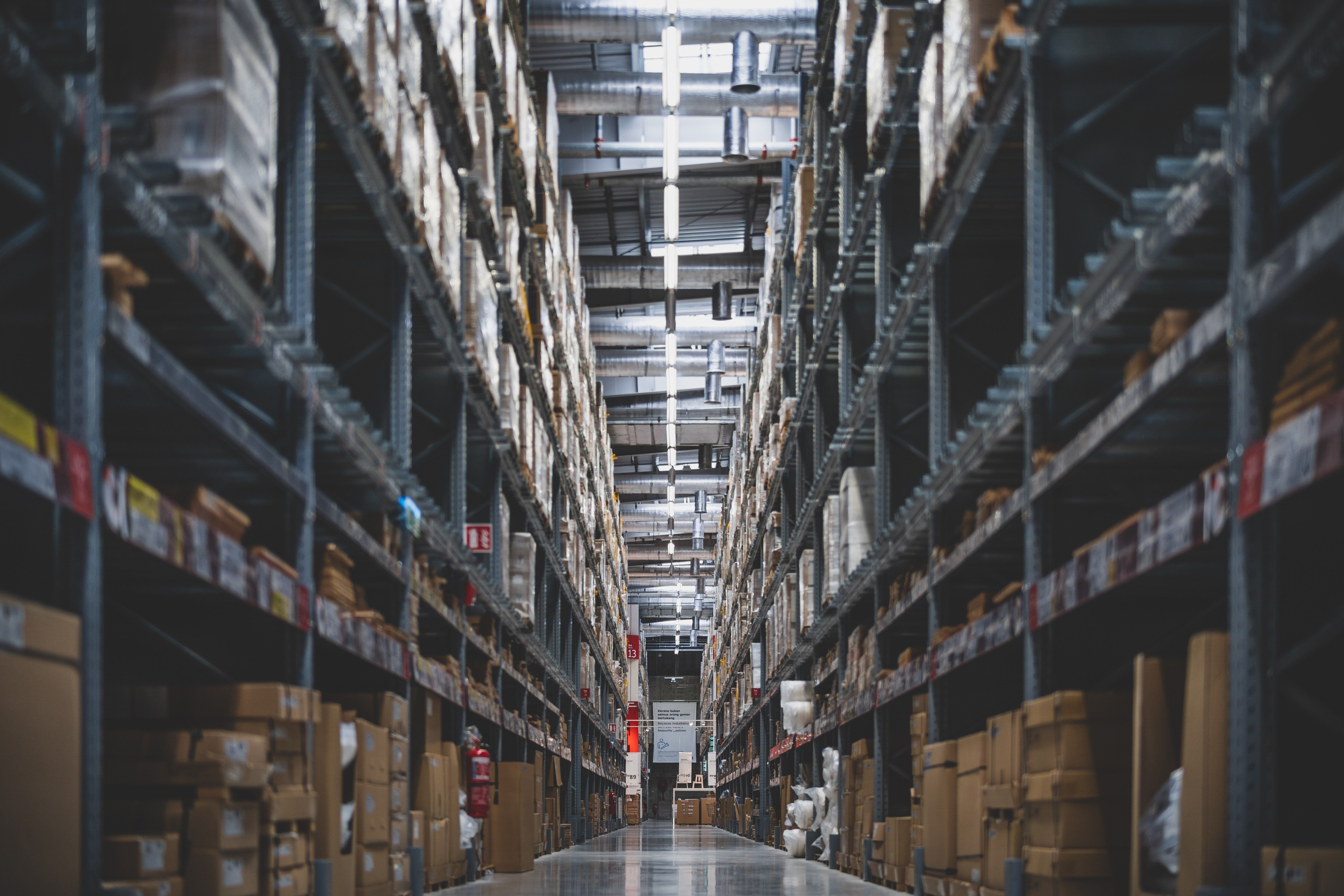
The warehouse is one of the most important areas in a distribution company.
It is also one of the areas where inefficiency becomes very costly.
AI can help improve warehouse operations by analyzing:
- Picking patterns.
- Product rotation.
- Order frequency.
- Stock locations.
- Replenishment needs.
- Operational bottlenecks.
- Product handling effort.
- Error patterns.
This can help answer practical questions.
Which products should be closer to the picking area?
Which items are often ordered together?
Where are delays happening?
Which products create the most handling effort?
Where are errors more likely to happen?
How can stock movements be better organized?
For companies with large warehouses, multiple locations, or high order volumes, these improvements can directly affect cost, speed, and customer satisfaction.
Logistics, Import, and Export
Distribution does not end when the product leaves the warehouse.
Delivery performance is part of the customer experience.
AI can help improve route planning, delivery scheduling, transport utilization, and exception management.
It can also help companies identify delays earlier, communicate better with customers, and reduce unnecessary transport costs.
For distributors involved in import and export, AI can support planning, supplier communication, documentation workflows, compliance checks, customs-related processes, and visibility across international operations.
This does not remove the complexity of logistics.
But it can make that complexity easier to manage.
Customer Support and Help Desk
Many distribution companies need to support customers before and after the sale.
Customers may ask about product availability, delivery status, technical specifications, invoices, returns, warranties, replacement parts, or repairs.
In many companies, support teams spend a lot of time searching for information across different systems, emails, spreadsheets, and internal messages.
AI can help support teams access information faster.
It can summarize customer history, classify support requests, suggest answers, retrieve product information, and automate responses to common questions.
The result is not only a lower help desk cost.
It is also faster and more consistent service.
And in distribution, fast service can become a real competitive advantage.
Repairs, Refurbishments, Returns, and Warranties
Some distribution companies do more than sell products.
They also manage returns, repairs, refurbishments, warranty claims, spare parts, and after-sales service.
This is common in sectors such as machinery, equipment, electronics, appliances, industrial tools, and other technical products.
These processes require coordination.
A returned product may need to be received, inspected, classified, repaired, replaced, credited, or refurbished.
A repair may require spare parts, technician availability, supplier communication, warranty validation, and customer updates.
AI can help organize and accelerate these workflows.
It can help identify common failure patterns, suggest repair steps, estimate turnaround times, classify warranty cases, and improve communication between sales, support, warehouse, finance, and technical teams.
For distributors that manage repairs or refurbishments, this can reduce costs and improve customer satisfaction.
Field Service
Some distributors sell products that require installation, maintenance, or repair at the customer’s location.
This is common when distributing machinery, industrial equipment, technical systems, or specialized products.
In these cases, field service becomes part of the business model.
AI can help coordinate technicians, service requests, spare parts, routes, customer history, maintenance plans, and service reports.
It can help answer questions such as:
Which technician is best suited for this job?
Which spare parts are needed?
Can this visit be combined with another nearby visit?
Has this customer had the same issue before?
Is this equipment likely to fail again?
What information should the technician know before arriving?
Better field service planning can reduce travel time, improve first-time fix rates, and increase customer satisfaction.
Pricing and Margin Control
In distribution, revenue is important.
But margin is what keeps the business healthy.
AI can help companies analyze pricing, discounts, supplier costs, customer profitability, product profitability, and margin erosion.
This is especially valuable when prices change frequently or when sales teams have flexibility to negotiate.
AI can help identify where margins are being lost.
It can show which customers are buying low-margin products, which products are becoming less profitable, and which discounts are damaging profitability.
This gives managers better visibility and helps sales teams make better commercial decisions.
Management Decisions
Many distribution companies already have a lot of data.
The problem is that the data is often difficult to use.
It may be spread across sales systems, accounting tools, warehouse software, spreadsheets, emails, and individual knowledge inside the company.
AI can help managers interpret business data more quickly.
Instead of spending hours preparing reports, leaders can ask better questions and get faster insights.
For example:
Which customers are becoming less active?
Which products are increasing in demand?
Which suppliers are becoming less reliable?
Which warehouse processes are creating delays?
Which products are reducing our margin?
Which service requests are increasing?
Which areas of the business need attention this week?
This kind of visibility helps management move from reactive decision-making to proactive decision-making.
4. But AI Needs Good Data to Create Real Value
This is one of the most important points for distribution companies to understand.
AI is not magic.
It needs information.
If business data is scattered across spreadsheets, emails, disconnected systems, paper documents, and individual employee knowledge, AI will have limited impact.
It may still help people write emails, summarize documents, translate content, or generate ideas.
But it will not transform the business.
The real value appears when AI can work with reliable and connected business data.
For a distributor, that means data such as:
- Customer data.
- Product data.
- Stock data.
- Purchase data.
- Sales data.
- Supplier data.
- Warehouse data.
- Delivery data.
- Repair data.
- Financial data.
- Service data.
This is why a modern ERP, or another integrated business management system, is becoming an essential foundation for companies that want to take AI seriously.
The point is not simply to have software.
The point is to create a structured digital foundation that AI can use.
5. Everyone Has Access to AI. Not Everyone Has the Right Foundation.
Today, almost every company can access tools like Claude, ChatGPT, Gemini, Copilot, or other AI assistants.
That means access to AI alone is not the competitive advantage.
The advantage comes from how well AI can be applied to your specific business.
A generic AI tool can help an employee work faster.
But AI connected to your business data and processes can help the whole company operate better.
That is a much bigger difference.
Two distribution companies may both use AI.
But if one has organized data, integrated systems, clear processes, and real-time visibility, while the other relies on spreadsheets, emails, and disconnected tools, they will not get the same results.
AI amplifies the quality of your digital foundation.
If the foundation is weak, AI provides limited benefits.
If the foundation is strong, AI can become a serious competitive advantage.
6. What Should Distribution Companies Do Now?
Distribution companies do not need to become AI companies.
But they do need to become AI-ready.
That starts with practical steps.
Identify where the business loses time, money, or service quality
Look at sales, purchasing, stock, warehouse operations, deliveries, customer support, repairs, finance, and reporting.
Where are the bottlenecks?
Where are costs too high?
Where do mistakes happen repeatedly?
Where are customers waiting too long?
These areas are usually the best starting points for AI.
Review where your data lives
Ask whether your business data is centralized, reliable, updated, and accessible.
Or is it spread across different systems, spreadsheets, emails, and individual employees?
AI needs good data to produce useful results.
Choose practical use cases
Do not start with AI because it is trendy.
Start where it can reduce costs, improve speed, increase margins, or improve customer service.
The best AI projects are not the most impressive ones.
They are the ones that solve real business problems.
Strengthen your digital foundation
For many distributors, this means implementing or improving an ERP system that connects the main areas of the business.
Sales, purchasing, inventory, warehouse, finance, support, repairs, and service should not operate as isolated islands.
They should be connected.
That connection is what allows AI to create deeper value. Take a look a Odoo ERP it's open and AI friendly as it integrates with existing LLM's but providing an internal context engine.
Start learning now
AI adoption is not a one-time project.
It is a continuous learning process.
Companies that start earlier will understand faster what works for their business, their customers, their team, and their market.
Final Thought: AI Will Reward the Best-Prepared Distributors
AI will not remove the fundamentals of distribution.
Companies will still need good suppliers, good products, good people, good service, and good customer relationships.
But AI will change how efficiently those fundamentals are managed.
It will help some companies sell better, plan better, stock better, deliver faster, support customers more efficiently, and make better decisions.
The key question is not whether AI will affect distribution.
It will.
The real question is whether your company will use AI before your competitors use it against you.
For distribution companies, the future advantage will not come only from having access to AI.
Everyone will have access.
The advantage will come from having the data, systems, processes, and mindset required to use AI well.
And that preparation should start now.

 Official Odoo Partner